 English
 Indonesia

Difference between Analog CCTV Cameras and IP Cameras.
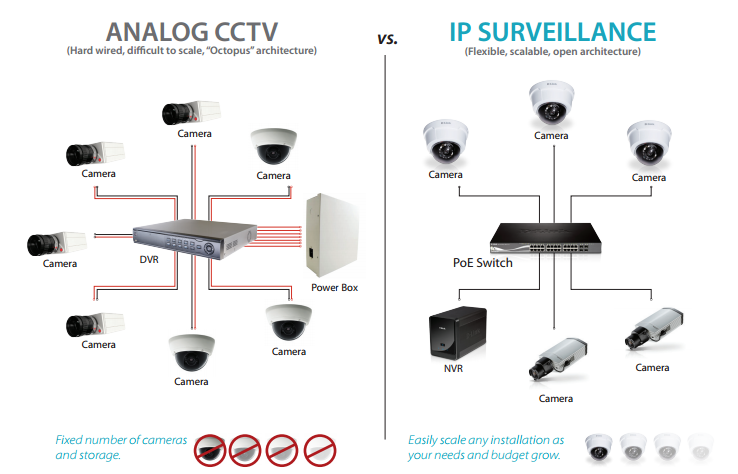
Difference between Analog CCTV Cameras and IP Cameras.
What you need to know as a user of analog CCTV cameras or IP cameras is that all CCTV can be accessed from the internet, monitoring from smartphones, tablets and desktop computers. As long as the Camera & NVR (IP Camera) or DVR (Analog Camera only) Device is connected directly to the WAN (Wide Area Network) network or Internet network.
In CCTV, the term analog camera is only used when our goal is to compare it with IP cameras so that they can be distinguished from one another. Analog cameras are ordinary CCTV cameras that use Coaxial cables, while IP cameras are cameras that use UTP cables or data cables to connect to the network. IP Camera is a camera that uses Internet Protocol technology (also known as TCP/IP protocol), while Video Balun is a system or tool for converting Coaxial cable to UTP cable. Both of them use the same type of cable, namely UTP Category 5 (Unshielded Twisted Pair).
Advantages of analog camera systems, including:
- Does not require complicated knowledge in learning it.
- There are many product variations, ranging from cameras, DVRs and other supporting equipment.
- The price is cheaper than the IP Camera of the same class.
- Easier equipment configuration and settings.
- Image quality is very good and object movement looks real.
- Video propagation can be further, because the cable can be longer.
- The price of DVR (promotional media) is getting cheaper.
The disadvantages of analog cameras are:
- Cable installation is a little more "heavy" than IP Camera. Especially if you have needs at multiple points.
- Coaxial cable and BNC connectors are more expensive than UTP and RJ-45 cables.
- Requires more cables for power, data and video.
- Easier to be affected by noise and interference.
- The equipment needed to integrate the system could be more.
Advantages of IP Camera over Analog:
- Less cable installation and compact.
- The cost of cables, connectors and other auxiliary materials can be lower.
- More resistant to noise and interference.
- If it will be transmitted over the air (wireless), then the wireless IP Camera is more secure from eavesdropping than analog cameras.
- Less equipment is needed to integrate the system.
- TCP/IP technology continues to grow rapidly, so that it can feature better features for the future.
While the disadvantages of IP cameras include:
- A solid understanding of the basics of LAN and Internet networks is required.
- Settings and settings are more complex.
- UTP cable length is limited by distance, theoretically maximum 100m. However, it can be helped by using a switch.
- The price of the camera is more expensive, as is the price of a PoE (Power over Ethernet) adapter.
- Standalone DVRs that directly support IP cameras (called NVRs or Network Video Recorders) are still few and quite expensive.
- Some NVR Software is still expensive.
- Bandwidth planning is an important issue.
- Compared to analog, object movements on IP cameras generally experience/like the motion of astronauts on the moon (moonwalk), except for high-end category products.
Add New Comment